There are two thermostats involved: the one to set the temperature at around 65 C or a little bit lower. Not lower than 55 C, legionella waiting.
Some thermostats have a little scroll wheel for fine tuning of the temperature range. Turning left/right several times might help to get rid of an intermittent contact(resistance) problem.
It is a series connection: the other other one is the safety thermostat with a fixed preset temperature of 90 C. Switches off if the adjustable temperature thermostat keeps on heating, defective. The red push button is for the safety thermostat. Sometimes nuisance triggering, pushing this button can be the solution.
Resistance measuring to be sure what is going on or not. Let the boiler cool down, switch the MCB to off and measure the stat with a simple continuity test. Should be close to zero Ohm. The same procedure for the boiler heating element, resistance between 15 Ω and 100 Ω.
MCBs of the lower ranking species (Deblex and others), special offers, only 4 euros, avoid them. Always problems, not doing anything, intermittent faults or switching off at too high or too low currents. Question: does yours feed the hungry boiler, open the
tableau électrique and check the two output contacts of your 16 or 20 amp MCB. A far better solution: use Schneider, Legrand, Hager, ABB or Siemens.
For those with a
contacteur jour/nuit (hc/hp) read this:
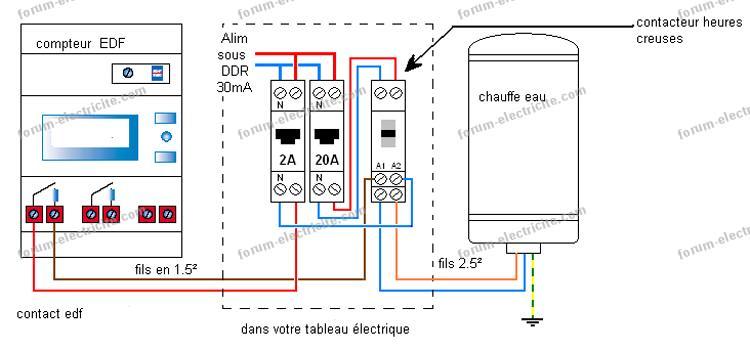
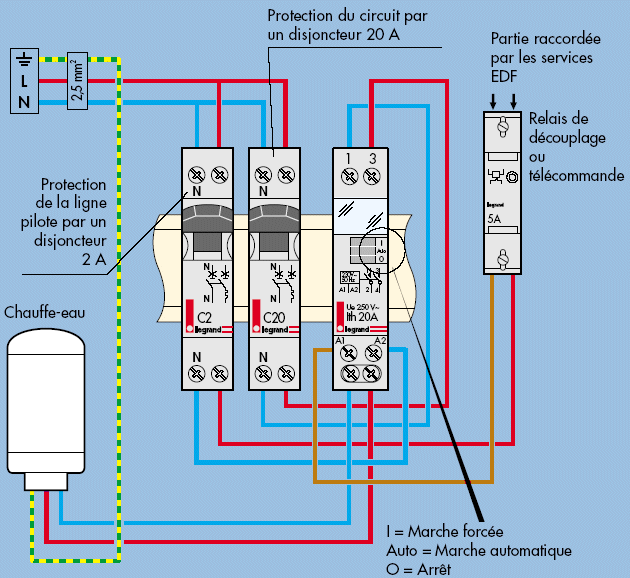
Two almost identical wiring diagrams to connect the contacteur jour/nuit for a chauffe-eau électrique. For a
modern digital meter and the slightly older arrangement with dial meter and a separate
relais de découplage. For a triphasé chauffe-eau, this is the
connection diagram. During heures pleines, the relay contact on the user side is open, easy to measure yourself by flipping up the protective cap at the bottom: then the
full mains voltage is across it. During the heures creuses, the relay is energised and you obviously measure zero volts across these two terminals. With the SAGEM digital meter (and the new Linky smart meter) the same story. There, it is about the contact points
C1 and C2 under the bottom cover. What is under the top lid is off limits to the user. Occasionally, the coil (
bobine) in the contacteur jour/nuit is broken. This is
easy to measure: between contact points A1 and A2 a resistance of about 3200 Ohm. But first switch off the main switch. Incidentally, you can also measure things with the mains voltage, see here for a
further explanation in French. Then you can check whether the control signal in the meter is doing its job. If the switch in the meter behind the two connection points C1 and C2 is doing its job, a possible problem lies in the wiring or the distribution board of the house installation. If the control signal turns out to be completely absent for several days, sometimes just overnight - then it is time to contact the network operator ENEDIS. Sometimes it is only a temporary ENEDIS problem: a day later and everything is back to normal. Or the little glass fuse inside a SAGEM meter, to protect the so called
fil-pilote signal (wake up / shut down) is defective, easy to replace.
According to the French regs (NFC 15-100), connecting such an electric boiler (
à accumulation) or a flow-through device (
instantané) is not allowed via a socket.