Page 1 of 1
Electrics question
Posted: Sat Dec 20, 2025 1:08 pm
by rabbit
I was working on a light fitting with the power off via the switch. The live and earth wires touched and the lighting circuit tripped. Is this due to a very low potential difference between the wires?
Is it normal?
Electrics question
Posted: Sat Dec 20, 2025 1:57 pm
by RobertArthur
Not normal, probably a live - neutral problem, reversed somewhere in the wiring. Your light switch functions as normal, but it switches the neutral. The false neutral to earth: short circuit. Work to do for the MCB or
RCD. An
interrupteur différentiel is a sensitive creature, it doesn't like
fault currents to earth of more than 30 mA at all.
Live-neutral reverse? Easy to measure with a high-impedance multimeter. One test lead to earth, then checking the two others, blue wire and then the brown/black/red wire (should be the switched live). Between earth and live the nominal 230 V, between ground and the real neutral a voltage of
2V or less.
Electrics question
Posted: Mon Dec 22, 2025 3:28 pm
by rabbit
Thanks Robert, but I still don’t understand how it could trip when the switch is off. I tested both live and neural were not live with a current detector
Electrics question
Posted: Mon Dec 22, 2025 3:44 pm
by RobertArthur
Single pole switch?
Current detector: neon test
screwdriver? Don't trust them, never. There is quite a difference between
ghost and hard voltages.
Electrics question
Posted: Wed Dec 24, 2025 7:47 am
by Biloute
Hi Rabbit,
The switch usually only interrupts the live wire. And the neutral wire remains "live" even if it's at roughly the same potential as earth.
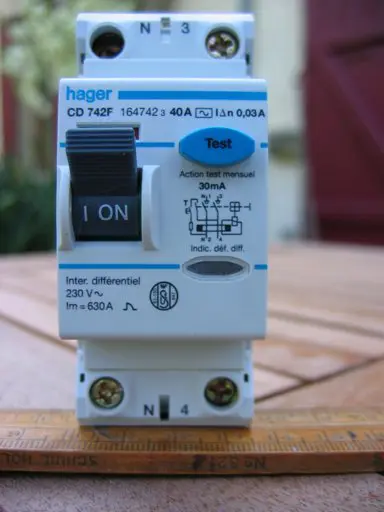
When you say "the circuit breaker tripped," are you referring to the main circuit breaker (at the head of the installation), a smaller branch circuit breaker protecting, for example, the lighting, or a residual current device (RCD)?
Circuit breakers only trip if the current exceeds their rated value (10, 16, 20, or 32 Amps). Residual current devices (RCDs) only trip if there is a current difference between phase and neutral (>30 milliamps or 500 mA for the main circuit breaker). If there is a difference, it means there is a current leak from the neutral or phase to earth. It's rare, but sometimes there are RCDs that protect against both overcurrent and leakage currents. If it's a small circuit breaker (only a standard circuit breaker) that has tripped, there is probably a phase-to-neutral reversal somewhere. If it's an RCD (switch or circuit breaker) that has tripped, this is normal because a neutral-to-earth contact can be enough to cause an imbalance of 30 or 500 mA. The neutral is generally at the same potential as earth, but it is only connected to it at certain points. Very far down the EDF (French electricity provider) grid, and by the time it reaches your home, there may be a slight potential difference. For any work on a light fixture, it's always safer to switch off the power at the corresponding circuit breaker (especially with questionable installations). Note that, unlike the wall switch in the room, which only cuts the live wire, the circuit breaker cuts both the live and neutral wires. Be careful: some older installations still have fuses that only cut the live wire...
Electrics question
Posted: Wed Dec 24, 2025 2:06 pm
by rabbit
Thanks Biloute and Robert. It was the RCD that tripped
Electrics question
Posted: Wed Dec 24, 2025 8:29 pm
by Biloute
So, you have your answer: the RCD has done it's job !

Electrics question
Posted: Sun Dec 28, 2025 5:40 pm
by rabbit
Another question Robert. I have some hanging ceiling lights where the outer insulation has been cut back too far and about 2cm of the conductors are showing. I don’t want to shorten the conductors so Is there a split sheathing that I can slip over ?
Electrics question
Posted: Sun Dec 28, 2025 5:57 pm
by RobertArthur
Cable sleeve? Cut 2 cm from a piece of wire (somewhere in your atelier?) and you'll have a perfect fit. Insulation tape - if the wiring of the ceiling lights is not visible - will do the job also.
Electrics question
Posted: Mon Dec 29, 2025 6:40 am
by Polarengineer
Another option is to slide a shrink-fit tube over the bare wire and part of its insulation, warm up with a match to shrink the tube. these tubes are available on internet in different sizes. Useful and cheap.
As an example….
https://www.amazon.fr/-/en/Arnocanali-P ... r=8-2&th=1